Why Bother Wrenching? The New Wave of Factory Rockets Is Challenging Everything the Mod Scene Stands For
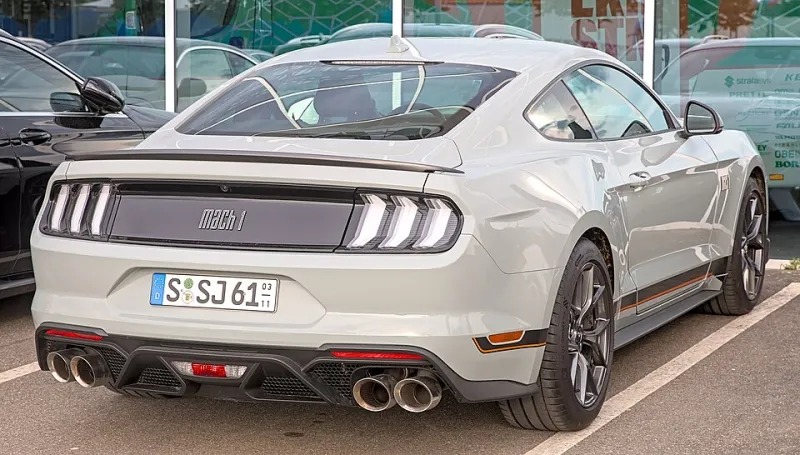
Photo: Alexander Migl, CC BY-SA 4.0, via Wikimedia Commons
There's a conversation happening in garages, on forums, and in the parking lots of every major car meet across the country right now. It doesn't start with horsepower numbers or dyno sheets. It starts with a question that would've sounded absurd a decade ago: Why modify anything at all?
Because the factories are catching up. Fast.
Stock Is the New Tuned
Let's talk real numbers for a second. The 2024 Ford Mustang Dark Horse ships with 500 horsepower from a naturally aspirated 5.0 Coyote, a Torsen limited-slip differential, Brembo brakes, and magnetic ride control tuned by the same engineers who developed the GT500's suspension geometry. It corners, stops, and pulls with a precision that would've required serious coin and serious wrench time to replicate on any previous-generation pony car.
The Dodge Charger's 6.1-liter HEMI — still a cult favorite among the muscle car faithful — punches out numbers that used to live exclusively in the territory of ported heads, cam swaps, and long-tube headers. And with Stellantis teasing the future of the Charger nameplate in an era of electrification, the performance ceiling on what a stock American muscle car can do is only getting more interesting.
Even overseas, the trend holds. The latest generation of factory track packages, driver modes, and electronically managed powertrains means that a motivated buyer can walk into a dealership and drive home in something that would've embarrassed a lot of weekend builds from 2018.
So where does that leave the guy with grease under his fingernails and a parts wishlist bookmarked on his phone?
The Enthusiast Divide
Marcus Webb, a 34-year-old mechanic out of Charlotte, North Carolina, has been building cars since his late teens. He's currently finishing a turbocharged S550 Mustang build that he estimates has absorbed close to $22,000 in modifications over three years. When asked about the Dark Horse, he doesn't flinch.
"That car is legitimately impressive," he admits. "But here's the thing — I didn't build my car to have a fast car. I built it because building is the point. The car's almost secondary."
That sentiment echoes across the enthusiast community, but it's not universal. Plenty of newer car people — younger buyers especially — are approaching performance with a different philosophy. Why spend years chasing a power number when you can finance something that already delivers it?
Jordan Tran, 26, bought a used Chevy Camaro SS 1LE last year and hasn't touched a thing under the hood. "I looked at what it would cost to get a base model to where this thing already sits," she says. "It didn't make sense. The factory literally did the work for me."
Both perspectives are valid. And that tension is exactly what's reshaping car culture in real time.
What Factories Know That Builders Don't
Here's something the mod community doesn't always want to hear: OEM engineers have access to resources that no backyard builder — and honestly, no independent shop — can match. Thousands of hours on private test tracks. Climate-controlled dynamometers. Software calibrated to work in harmony with every system in the car simultaneously.
When Ford engineers tune the Dark Horse's suspension, they're not guessing at spring rates. They're iterating through data collected over millions of test miles. When GM calibrated the 1LE's chassis, they weren't working off forum threads and YouTube installs.
The result is a kind of holistic performance that bolt-on builds sometimes struggle to replicate. You can throw headers, a tune, and a cold air intake at a car and gain 40 horsepower — but if the suspension geometry, brake bias, and traction control mapping aren't recalibrated around those changes, you've created a faster car that doesn't necessarily handle better. Factory performance packages solve for the whole equation.
That's not a knock on modifiers. It's just the reality of what OEM development budgets buy.
The Camaro Question
And then there's the elephant in the room: the Camaro's impending return. GM pulled the plug on the sixth-gen in 2024, but rumors of a revival — potentially on a new platform, potentially with a hybrid or EV powertrain — have been circulating with enough credibility to keep enthusiasts both nervous and excited.
If that car comes back and delivers factory performance numbers that rival what today's most aggressive builds produce, it could represent a turning point. Not the death of the mod scene, but a genuine redefinition of what "building a car" means when the baseline keeps rising.
The Modification Community Isn't Dead — It's Evolving
Here's the thing: the aftermarket isn't going anywhere. What's changing is why people modify.
The era of chasing a stock car until it becomes something it wasn't born to be — that's getting harder to justify on pure performance grounds alone. But modification has always been about more than lap times. It's about identity. It's about the story a car tells about the person who built it. A Dark Horse is impressive. A Dark Horse with a custom widebody, a livery that means something to its owner, and a tune dialed in over a hundred track sessions? That's a different thing entirely.
The shift happening right now is that performance is becoming the starting point rather than the destination. Factories are handing enthusiasts a capable platform and saying, essentially, now make it yours.
For the mod community, that's not a threat. It's an invitation.
The Bottom Line
The golden age of building to compete with factory performance may be winding down. But the golden age of building to express something — to take a capable machine and push it further, make it weirder, make it more personal — that's as alive as it's ever been.
The factories raised the floor. What the community does with that is the real story.
And if the last decade of American car culture taught us anything, it's that enthusiasts don't need a reason to wrench. They just need a car worth caring about.